Four-tonne Falcon 9 stage crashes on the Moon
FRANCE 24 English · 2026-08-05
Impact-day report: what is known about the object and the site it hit.
Open the source
5 August 2026 · 06:34 UTC
An upper stage adrift for eighteen months slammed into the Moon at 8,700 km/h near the Einstein and Bell craters. Here are the verified facts, the story behind the event and the only authentic videos.
Impact
5 Aug 2026 · 06:34 UTC
Speed
2,43 km/s · 8 700 km/h
Mass
≈ 3 900 kg
Location
Einstein / Bell craters
The impact was unintentional, as confirmed by SpaceX. The object is upper stage 2025-010D, launched on 15 January 2025 with the Blue Ghost 1 and Resilience (Hakuto-R M2) landers. It posed no danger to Earth.
From the liftoff of a commercial lunar mission to a crater photographed from orbit: eighteen months adrift and an unanswered question about space debris.
15 January 2025
A Falcon 9 lifts off from Florida with two lunar landers: Blue Ghost 1 (Firefly) and Resilience / Hakuto-R M2 (ispace). Once its job is done, the upper stage (catalogued 2025-010D, ~3,900 kg) is left on a high orbit.
2025 — 2026
With no propellant left for controlled disposal, the stage follows a chaotic path perturbed by Earth, Moon and Sun. No official body tracks this kind of object beyond Earth orbit.
July 2026
Astronomers — including Bill Gray (Project Pluto), who raised the 2022 alert — compute a collision with the Moon. Teams publish ejecta-plume predictions and an observing plan on arXiv; NASA announces a tracking campaign.
5 August 2026, 06:34 UTC
The stage strikes the Moon at about 2.43 km/s (8,700 km/h) near the craters Einstein and Bell, on the western limb. No telescope confirms the flash: the object is too small and the site too foreshortened.
6 August 2026
South Korea's Danuri orbiter (KASA) flies over the site and releases before/after views, compared with a NASA image from 1 October 2015: a dark spot marks the new crater.
Next
NASA's Lunar Reconnaissance Orbiter is set to image the site at high resolution to measure the crater precisely — as it did in 2022 for the double crater of the Chinese impact.
Einstein crater, about 200 km wide, sits on the Moon's western limb: seen from Earth it appears heavily foreshortened, which explains why the impact was so hard to observe.
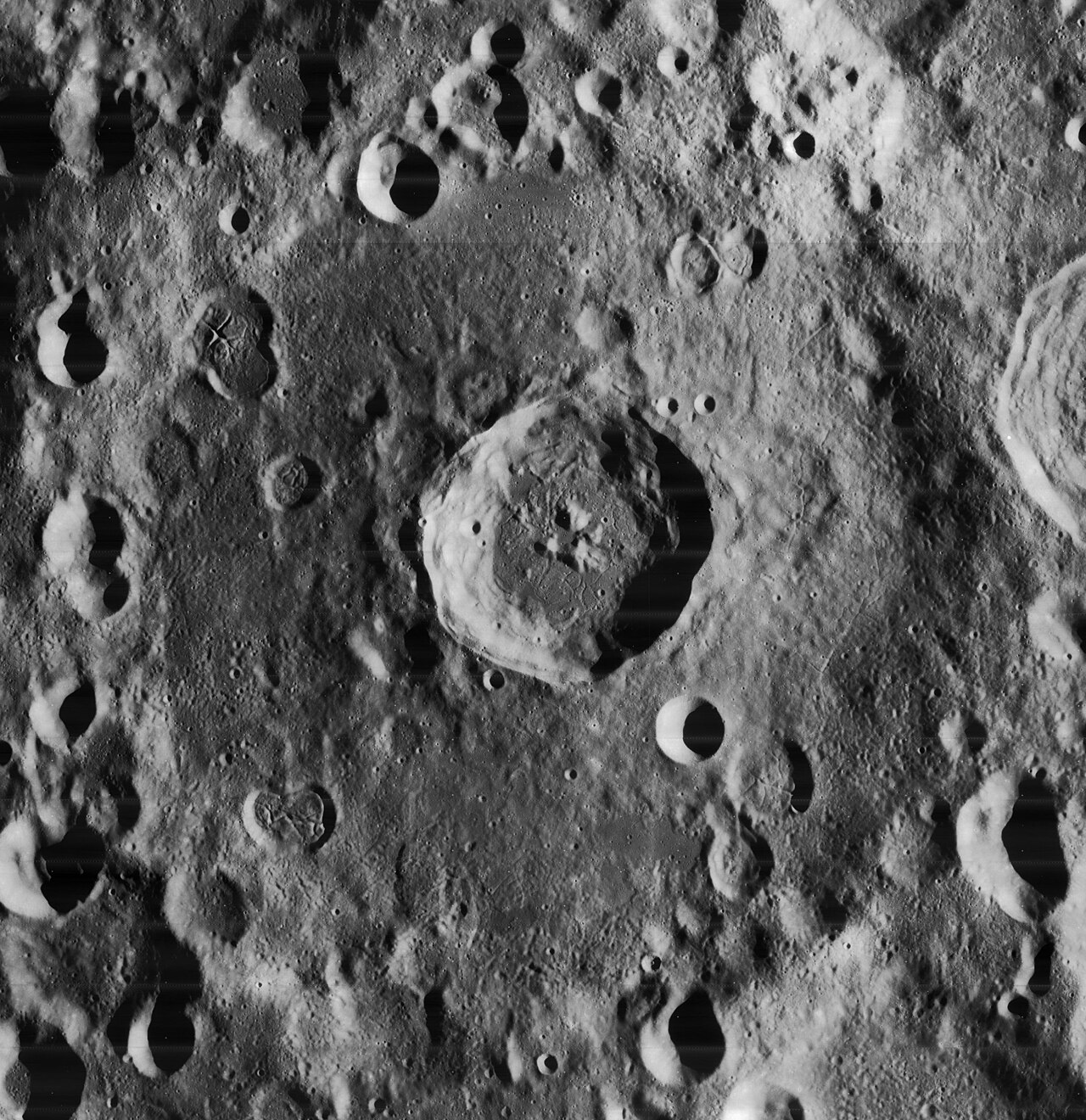
The before/after images of the new crater come from the Danuri orbiter (KASA) and are distributed by news agencies; they can be viewed through the official sources listed below.
Only videos whose channel and publication date were verified: established news outlets and astronomy societies. No simulations, no AI renders.
FRANCE 24 English · 2026-08-05
Impact-day report: what is known about the object and the site it hit.
Open the sourceFort Worth Astronomical Society · 2026-08-05
Real observing conditions: why the impact flash stayed invisible.
Open the sourceABC News (Australia) · 2026-07-31
The pre-impact context: trajectory, prediction and the space-debris debate.
Open the sourceNo camera was on site and no ground telescope captured the impact flash: the object was too small and the site too close to the limb. Any video showing a close-up explosion, a spectacular plume or a "live from the Moon" feed is fabricated.
No treaty requires disposal of stages sent beyond Earth orbit, and no official catalogue tracks them. Monitoring relies on volunteer astronomers.
An impact with known mass and speed is a textbook case: ejecta plume, wave propagation, calibration of future lunar seismic networks.
As commercial missions multiply, traffic and disposal rules in lunar orbit become a safety issue for future crewed bases.
No. The object weighed only about 3.9 tonnes and struck near the western limb, at a very grazing angle as seen from Earth. Despite an international observing campaign, no telescope confirmed an impact flash.
On 5 August 2026 at about 06:34–06:35 UTC, near the craters Einstein and Bell, at roughly 19.45° N and 93.59° W, on the Moon's western limb.
The upper stage of a Falcon 9, catalogued 2025-010D, launched on 15 January 2025 with the Blue Ghost 1 (Firefly) and Resilience / Hakuto-R M2 (ispace) lunar landers. It had been drifting for eighteen months on a chaotic orbit, with no propellant left for controlled disposal.
No. SpaceX stated the impact was unintentional. Upper stages sent beyond Earth orbit usually have too little propellant left for a controlled disposal trajectory.
No, and it is a common confusion. In March 2022 a stage first attributed to a Falcon 9 (DSCOVR mission) hit the far side; it turned out to be a Chinese Chang'e 5-T1 booster, and LRO photographed an unexpected double crater there.
No. The Moon constantly receives far more energetic natural impacts. The object created a small crater a few metres to a few tens of metres across, visible as a dark spot in the Danuri imagery.
South Korea's Danuri orbiter (KASA) produced the first before/after views of the site, compared with a NASA image from 1 October 2015. NASA's Lunar Reconnaissance Orbiter is then expected to deliver high-resolution views.
In practice, nobody. There is no binding rule and no official catalogue of objects abandoned beyond Earth orbit: tracking largely relies on amateur astronomers and a few academic teams.